About
Checkout this learning outcomes and program description for this year's symposium!
Schedule
Check out some of the incredible breakout sessions and learning labs taking place at this year's symposium!
Call for Programs
We are looking for folks to submit proposals to present at this year's symposium!
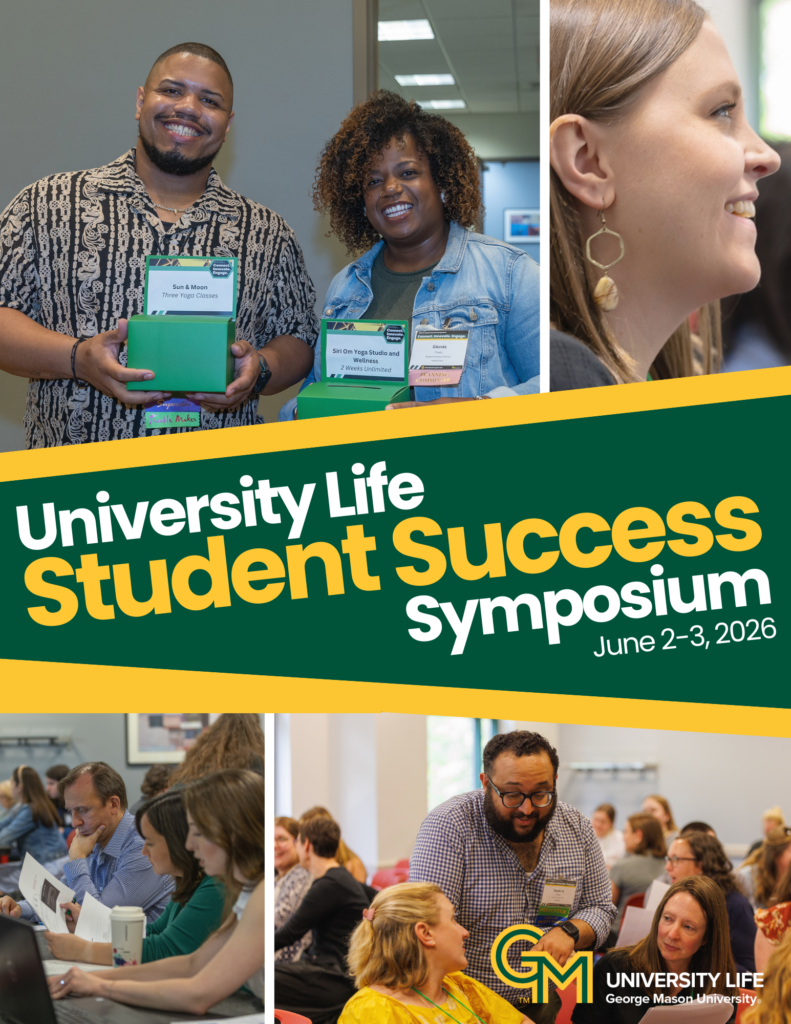
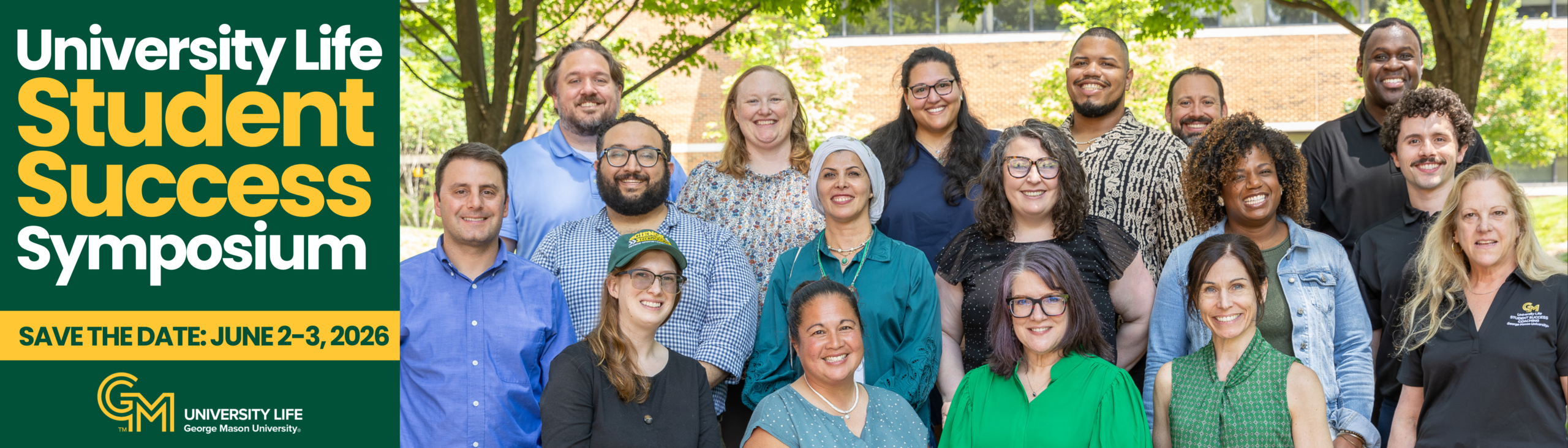
The University Life Student Success Symposium is the division’s annual signature professional development experience, offering a meaningful opportunity to connect with colleagues and engage in topics central to our shared work. As a collaborative UL community, we deepen our understanding of one another’s contributions and strengthen our collective commitment to student success.
The 2026 UL Symposium invites us to reflect and prepare for the year ahead through interactive and engaging experiences grounded in the UL Core Values. Throughout the event, we will enrich our professional practice by embodying these values, aligning them with our daily efforts, and putting them into action across our roles. The symposium highlights the innovative and ongoing work of George Mason student affairs professionals, provides access to career and leadership development opportunities, introduces emerging practices and technologies that support our work, and explores current trends shaping the student and staff experience in today’s evolving higher education landscape.
Through participation in the 2026 University Life Student Success Symposium, attendees will:
Leverage Innovative practices to enhance student success
Strengthen informed and ethical stewardship by creatively managing structures, various resources, and using data-guided, responsible decisions to improve student outcomes and experiences.
Advance inclusion and community connection
- Explore inclusive engagement practices to build understanding of community building needs within diverse student populations
Enhance leadership, collaboration, and professional effectiveness
- Learn effective leadership behaviors through collaborating, communicating, and applying project management and team effectiveness strategies
Prioritize well-being, safety, and holistic care for students and staff
- Identify approaches that promote holistic well-being, strengthen campus safety, and support the student and staff experience
Integrate ethical, innovative, and future focused uses of technology
- Evaluate ethical, innovative, and emerging technologies to enhance learning, service delivery, and operational effectiveness
Engage in evidence informed practice across policy, governance, and higher education systems
- Explore policy, governance, and higher education structures to determine their impact on student success and institutional decision making
We will be using the University Life Core Values for the Call for Programs. Presenters will be asked to pick a primary value and secondary (not required to have a secondary value) to link to their presentation material. Presenters may not select more than 2 values.
TOGETHER, we achieve our mission through an unwavering commitment to our values:
Inclusion and Opportunities: We are committed to cultivating an environment of engagement, connection, and belonging that is respectful and fair for everyone.
Leadership for Positive Change: We are committed to cultivating leaders who critically examine and understand the potential impact of their decisions and act ethically.
Well-Being: We are committed to cultivating an environment of understanding and fulfillment of both individual and community well-being that promotes purpose, vitality, engagement, and resilience.
Collaborative Community: We are committed to cultivating a supportive network of colleagues that share ideas, learn and create together, and develop authentic connections.
Strategic Transformation: We are committed to dynamic action in creating meaningful solutions to anticipate and meet the needs of an ever-changing community.
Law, Policy, and Governance: Includes the knowledge, skills, and dispositions relating to policy development processes used in various contexts, the application of legal constructs, compliance/policy issues, and the understanding of governance structures and their impact on one’s professional practice.
- Professional Development: Progression from foundational to advanced level proficiency reflects shifts from understanding to critical applications enacted primarily at the departmental level to institutional level applications that are mindful of regional, national, and international contexts.
Social Justice: While there are many conceptions of social justice and inclusion in various contexts, for the purposes of this competency area, it is defined here as both a process and a goal which includes the knowledge, skills, and dispositions needed to create learning environments that foster equitable participation of all groups while seeking to address and acknowledge issues of oppression, privilege, and power. This competency involves student affairs educators who have a sense of their own agency and social responsibility that includes others, their community, and the larger global context. Student affairs educators may incorporate social justice and inclusion competencies into their practice through seeking to meet the needs of all groups, equitably distributing resources, raising social consciousness, and repairing past and current harms on campus communities.
- Professional Development: Professional development within this competency areas assumed that student affairs educators need to understand oppression, privilege, and power before they can understand social justice. Intermediate and advanced level outcomes reflect social justice-oriented applications in practice and then interconnections between leadership and advocacy.
Student Learning and Development: Addresses the concepts and principles of student development and learning theory. This includes the ability to apply theory to improve and inform student affairs and teaching practice.
- Professional Development: At the foundational level, SLD involves a critical understanding of learning and development theories and their use in constructing learning outcomes. Intermediate and advanced proficiency involves greater application in utilizing various forms of programs and applications within increasingly large and complex venues.
Technology: Focuses on the use of digital tools, resources, and technologies for the advancement of student learning, development, and success as well as the improved performance of student affairs professionals. Included within this area are knowledge, skills, and dispositions that lead to the generation of digital literacy and digital citizenship within communities of students, student affairs professionals, faculty members, and colleges and universities as a whole.
- Professional Development: Professional growth in this competency area is marked by shifts from understanding to application as well as from application to facilitation and leadership. Intermediate and advanced level outcomes also involve a higher degree of innovativeness in the use of technology to engage students and others in learning processes.
Leadership: Addresses the knowledge, skills, and dispositions required of a leader, with or without positional authority. Leadership involves both the individual role of a leader and the leadership process of individuals working together to envision, plan, and affect change in organizations and respond to broad-based constituencies and issues. This can include working with students, student affairs colleagues, faculty, and community members.
- Professional Development: Professional growth within this competency area reflects shifts from knowledge to critical application and then to fostering the development of leadership within and among others.
Organizational and Human Resources: Includes knowledge, skills, and dispositions used in the management of institutional human capital, financial, and physical resources. This competency area recognizes that student affairs professionals bring personal strengths and grow as managers through challenging themselves to build new skills in the selection, supervision, motivation, and formal evaluation of staff; resolution of conflict; management of the politics of organizational discourse; and the effective application of strategies and techniques associated with financial resources, facilities management, fundraising, technology, crisis management, risk management and sustainable resources.
- Professional Development: In addition to the shift from understanding to application, professional development within this competency reflects shifts in the scale, scope, and interactivity of the human and organizational resources with which one works.
The University Life Symposium Planning Team invites all Mason faculty, staff, and graduate students to submit program proposals for the upcoming 2026 University Life (UL) Student Success Symposium! The UL Pre-Symposium is taking place on Tuesday, June 2, 2026, and the UL Symposium on Wednesday, June 3, 2026.
Important Information
- Program proposals are due no later than Monday April 13, 2026, by Noon.
- To submit a program proposal, please complete the online proposal form
Registration for the 2026 UL Student Success Symposium will open in early April.