UL Student Success Pre-Symposium Workshops: June 2, 2026
Check-In
8:30am-9:00am
Johnson Center, 3rd Floor Alcove
Pre-Symposium Workshop (9:00am-12:00pm)
Presenters: Rachel Wernicke (University Life) and Malia Wernicke (University Life)
Location: Johnson Center, 3rd Floor, Room B
As Mason advances as an R1 and Minority‑Serving Institution, leaders must foster innovation and collaboration to meet evolving student needs and sustain the workforce. This session focuses on Psychological Safety, one of University Life’s Common Team Elements, and explores how leaders create high‑accountability cultures where people can speak up, challenge assumptions, learn from intelligent failures, and support inclusive, high‑performance teams and employee well‑being.
Presenters: Birgit Debeerst (UL Process and Project Management), Susan Pilley (UL Process and Project Management), Adriene Watson Boyce (UL Process and Project Management), Dmitry Veretennikov (UL Process and Project Management), and Nico Marin (UL Process and Project Management
Location: Johnson Center, 3rd Floor, Room C
In today’s changing landscape of higher education, a traditional degree isn’t enough to thrive. Student affairs professionals need skills in systems thinking, problem solving, goal setting, data analysis, project and change management, and user-centric design. This interactive workshop shows why these skills matter and how to get started. It also explores how AI can support these skills where appropriate, helping you work smarter and make a greater impact.
Presenters: Salma Elbeblawi (University Career Services), Saskia Campbell (University Career Services), Ali Bartow-Nelson (Student Centers), and Kimberly Seligman (Undergraduate Education)
Location: Johnson Center, 3rd Floor, Room D
Discover how to transform on-campus student employment into a high-impact practice that bridges academic learning with real-world application. In this interactive session, led by Human Resources and experienced supervisors, participants will explore strategies to support working learners in developing career readiness competencies. Through practical discussions, case studies, and collaborative exercises, participants will learn to foster inclusive workplace cultures, embed learning objectives and give feedback effectively for student employees.
Presenters: Maddy Quidzinski (Student Support and Advocacy Center), Matthew Carlos (Student Support and Advocacy Center), and Patty Millan (Police and Public Safety)
Location: Johnson Center, 3rd Floor, Room E
Learn hands-on tools and skills to support students in distress, including helping them identify their needs and navigate difficult situations as well as how you can recognize safety risks. The session also covers when and how to report concerns to SSAC, CAPS, and GMUPD. Through role play and discussion, participants will build confidence and leave better prepared to support students effectively.
Break (12:00pm-1:00pm)
Break
Johnson Center, 3rd Floor Room A
NOTE: Boxed Lunch provided to participants attending 2 Pre-Symposium Workshops
Check-In
12:30pm-1:00pm
Johnson Center, 3rd Floor Alcove
Pre-Conference Workshops/Passion Programs (1:00pm-4:00pm)
Presenters: Dmitry Veretennikov (UL Process and Project Management and Birgit Debeerst (UL Process and Project Management)
Location: Johnson Center, 3rd Floor, George's
This hands on workshop introduces a practical approach to building dashboards in Excel using raw data. Participants will build interactive, user friendly visuals from a shared dataset and learn how dashboards can highlight patterns and support everyday decision making. The session will also clarify what dashboards can and cannot do, helping attendees set realistic expectations and use dashboards more effectively in higher education contexts. No advanced technical background is required. Please bring your laptop.
Presenter: Lisa Snyder (Center for Leadership and Intercultural Engagement), Andy Brown (Center for Leadership and Intercultural Engagement), Sona Adhithi Yathavamoorthy (Center for Leadership and Intercultural Engagement), and Maya Pesjak Richardson (Center for Leadership and Intercultural Engagement)
Location: Johnson Center, 3rd Floor, Room C
This session examines how digital portfolios can serve as a reflective tool for documenting student learning, leadership development, and professional growth. Using a framework grounded in the UL Student Learning Domains and NACE Career Readiness Competencies, participants will workshop ideas, map learning outcomes, and prototype portfolio components. The session also highlights student voices, offering insights from students on how creating a digital portfolio has shaped their educational and professional journeys.
Presenters: Rachel Lindsey (University Career Services), Sarah Ahmed Atif (Office of the University Ombudsperson), and Dennis Kisielewski (Mason Recreation)
Location: Johnson Center, 3rd Floor, Room D
Ensure consistent, reliable student services—even during staff transitions or in flexible work environments. This interactive workshop helps supervisors and team leaders build sustainable, shared practices that reduce reliance on individual knowledge. Participants will examine a key process within their teams, identify gaps in documentation and communication, and develop practical strategies to improve coordination, continuity, and long-term team effectiveness.
Presenters: Ethan Carter (Mason Recreation) and Connor Zuidema (Mason Recreation)
Location: Johnson Center, 3rd Floor, Room E
Your data may be clear to you, but is it clear to others? This hands-on session helps participants transform cluttered visualizations into clear, compelling insights and learn how to communicate data in ways that audiences understand, remember, and act on.
Headshots (12:00pm-3:00pm)
12:00pm-3:00pm
SUB I Quad
Rain location: SUB I, Room 4210
UL Student Success Symposium: June 3, 2026
Check-In: 8:30am-9:00am
8:30am-9:00am
Johnson Center, Ground Floor Lobby
First Time Attendee Coffee Reception: 8:30am-9:00am
8:30am-9:00am
Johnson Center, Bistro (Invitation Only)
Welcome: 9:10am - 9:40am
9:10am - 9:40am
Johnson Center, Dewberry Hall
Snacks for Sustenance: 9:30am-3:00pm
9:30am-3:00pm
Grab and go snacks throughout the day for participants between sessions.
Johnson Center, 3rd Floor Alcove
Educational Session #1: 9:50am-10:50am
Speaker: Kaitlin Cicchetti (University Life) and and Angelina Jarrouj (Office of Advancement and Alumni Relations)
Location: Johnson Center, 3rd Floor, George’s
Grant funding can be a valuable tool to support your work and ideas. This session offers a clear, beginner-friendly introduction to grant funding, including where to find them and how to get started. Participants will learn the difference between philanthropic and non-philanthropic grants, how to identify the right opportunities, and the basics of a strong application—no prior experience required.
Presenters: John Cicchetti (University Life) Chelsey Ellard (Police and Public Safety), and Naomi Martinez-Jones (Disability Services)
Location: Johnson Center, 3rd Floor, Room A
Attendees will explore behaviors that may lead to safety concerns. An overview of neurodivergence will be provided and how certain actions may be outside of "the norm" but not necessarily threatening. The goal is to help attendees determine how to navigate these behaviors and the appropriate way to engage or report if necessary. An emphasis will be placed on enhancing inclusive engagement with individuals with disabilities to promote well-being and community safety.
Presenters: Aliya Rinaldi (Auxiliary and Business Services) and Nelcy Cespo (Auxiliary and Business Services)
Location: Johnson Center, 3rd Floor, Room B
Email remains one of the most effective yet underutilized tools for student engagement. This session explores how to move beyond basic campaigns to strategic, data-informed email marketing. Participants will learn how segmentation, A/B testing, and platform tools like Emma’s Suggested Send can improve engagement and outcomes. Real examples will highlight design trends, content strategies, and actionable techniques to enhance student communication.
Presenters: Jamie Kizer (Human Resources)
Location: Johnson Center, 3rd Floor, Room C
You carefully crafted your message. You delivered it with confidence. So why didn't it land the way you expected? In this dynamic 60-minute session, leaders will explore the three critical elements of communication: Intent, Delivery, and Impact. Discover why the most overlooked element is the one you control the least. Through real-world scenarios, honest reflection, and interactive discussion, participants will examine how generational differences, cultural lenses, lived experiences, and emotional state all shape the way messages are received.
SESSION CANCELLED
Presenter: Hailie Baker (Student Support and Advocacy Center)
Location: Johnson Center, 3rd Floor, Room D
Responding to disclosures of sexual or interpersonal violence can be difficult to navigate, especially as responsible employees. Join us in a discussion on how to be a trauma-informed advocate in our everyday lives and explain Title IX reporting responsibilities to students.
Presenters: Alexis Beard (New Student and Family Programs and Services), Caroline Simpson (New Student and Family Programs and Services), and Clarisse Ladaban (New Student and Family Programs and Services)
Location: Johnson Center, 3rd Floor, Room E
Leveraging diverse creativity types within a student team is essential to building inclusive, communities. In this session, participants will explore how creativity shows up in the student leadership roles they supervise and how to recognize and affirm each team member’s contributions. Participants will discover new strategies and leave with actionable approaches and a new tool for implementing creativity-based leadership and teamwork on their teams.
Presenter: Laxmi Shastry (Human Resources)
Location: Johnson Center, 3rd Floor, Room F
What if we worked in environments where we felt confident we would 'not be punished or humiliated for speaking up with ideas, questions, concerns, or mistakes'? What would be possible then? How can we build this sense of 'safety' from any role?
This session introduces 'team psychological safety' and why it matters. Participants will also use a model/assessment (SCARF)to identify (a) their individual safety needs and (b) practices for cultivating a 'safer' environment for their reports, colleagues, and teams.
Presenters: Esther Knight (Student Involvement) and Nicolas Marin Ciro (University Life)
Location: Johnson Center, 3rd Floor, Room G
Student affairs professionals often treat AI as a one-time catalyst instead of a scalable strategy for student support. University Life is leveraging process improvement and design thinking to expand capacity and empower students to navigate systems more independently. This session features case studies from PPM and SI, highlighting cross-collaboration and AI integration to elevate the student club journey. Participants will leave with practical ideas for collaboration, new tools, and concrete steps to implement AI within their unit.
Educational Session #2: 11:00am-12:00pm
Speaker:Dr. Joisanne Rodgers (Contemporary Student Services) and Dr. Adrien DeLoach (Virginia Commonwealth University)
Location: Johnson Center, 3rd Floor, George’s
The session explores the unique professional journeys of two higher education leaders who began their careers together as graduate students and housing professionals at the same university. Now working in distinct areas of higher education, their stories highlight how shared beginnings can lead to divergent yet impactful career paths. Through an engaging discussion, attendees will gain insights into the varied trajectories within higher education and the transferable skills that support professional growth across roles. We hope the session will inspire participants to reflect on their own career pathways and the possibilities within the field.
Presenter: Dr. Julia Benedith-William (University Career Services)
Location: Johnson Center, 3rd Floor, Room A
In an era of ever-changing student needs, the "coach approach" transforms University Life staff from service providers into catalysts for growth! This session explores how shifting from advising to active inquiry empowers students to own their academic, personal, and professional journeys. Participants will learn to use powerful questions and active listening to build student resilience and self-agency. Move beyond giving answers; join us to master practical coaching tools that foster holistic success in every student!
Presenters: Maggie Daniels (College of Education and Human Development), Lauren Long (Student Involvement), and Hope Miller (Student Involvement)
Location: Johnson Center, 3rd Floor, Room B
University Life professionals facilitate the undergraduate journey by offering diverse extracurricular and co-curricular opportunities that encourage participation and contribute to student learning and well-being. This session focuses on highlighting pre- and post-pandemic trends in student involvement at George Mason, using findings from the 2019 and 2026 assessments. Implications for strategic planning will be discussed interactively, in relationship to communication, participation barriers, satisfaction, and maximizing student outcomes.
Presenters:Austin Deray (Graduate Student Life), Muna Al Taweel (Graduate Student Life), Nilima Mow (GAPSA) and Eelma Ahmed (GAPSA)
Location: Johnson Center, 3rd Floor, Room C
Graduate student programs often prioritize support but lack intentional pathways from participation to leadership, leaving many students as passive recipients rather than active contributors. This session introduces a model connecting support, connection, and leadership as an integrated pathway. Drawing on student-led initiatives at George Mason University, it explores how programs can create accessible entry points, foster engagement, and empower leadership. Participants will gain practical strategies to design more engaging, student-centered,
Presenter: Jennifer De La Rosa (University Life Marketing and Communications)
Location: Johnson Center, 3rd Floor, Room D
The majority of higher education departments have small (but mighty) marketing teams. Staff with partial marketing oversight supporting the unit marketing, or staff who wear multiple hats and marketing is just a small part of their world. Join us for a session of marketing basics - learn how to create an annual marking plan, best practices for tying in (and finding) the best campus communications channels, setting up your team makeup, and how to find success as a "non-marketing marketer."
Presenters: Maddy Quidzinski (Student Support and Advocacy Center), Matthew Carlos (Student Support and Advocacy Center), and Patty Millan (Police and Public Safety)
Location: Johnson Center, 3rd Floor, Room E
Learn hands-on tools and skills to support students in distress, including helping them identify their needs and navigate difficult situations as well as how you can recognize safety risks. The session also covers when and how to report concerns to SSAC, CAPS, and GMUPD. Participants will leave better prepared to support students effectively and recognize their role in that process.
Presenter: Brent Ericson (Office of Student Conduct)
Location: Johnson Center, 3rd Floor, Room F
Ever make a decision and then rethink its impact? Are you reflective in your practice? How do you 'bounce'? Student affairs practitioners are asked to make difficult decisions and sometimes, while we may not like to admit it - we fail, and wish we could turn back the clock. Rooted in both research and experience, this session will address how we can learn and grow from our experiences including negative, crisis, and traumatic situations, and how to work toward growth, professional resilience, and resilient leadership.
Presenters: Nina Cox (University Career Services) and Rachel Lindsey (University Career Services)
Location: Johnson Center, 3rd Floor, Room G
As skills-based hiring continues to shape the job market, University Life staff play a key role in helping students recognize and articulate skills gained through campus roles & experiences. This session raises employer trends and the NACE Career Readiness Competencies, then guides participants through activities to identify & connect existing skill development in their units to a career readiness lens. Attendees will leave with adaptable strategies to elevate career growth in their daily work.
Lunch: 12:10pm-1:10pm
12:10pm-1:10pm
Lunch
Johnson Center, Dewberry Hall
Educational Session #3: 1:20pm - 2:20pm
Speaker: Dr. Sally Lorentson (University Life), Dr. Alan Byrd (Admissions) and Alison Smith (University Business Consulting)
Location: Johnson Center, 3rd Floor, George’s
College is challenging – especially for students facing financial barriers and competing priorities. At George Mason, more than 35% of undergraduates are Pell–eligible, indicating high financial need. Drawing on data from a recent Institution‑Wide Barrier Review, this session will examine Pell‑eligible students’ experiences as well as our current strategies to address enrollment and retention. Participants will have time to reflect and collaborate to identify actionable ways to reduce barriers and increase student success in their own units.
Presenters: Lu GK (LGBTQ+ Resources Center), Isa Olivo (LGBTQ+ Resources Center), and Jordan Rizzo (LGBTQ+ Resources Center)
Location: Johnson Center, 3rd Floor, Room A
Join the LGBTQ+ Resources Center to hear about our experiences balancing the complexity of inclusive community and the critical role of student facilitators in our community space. Attendees of the session will have the opportunity to share their own promising practices of engaging in such work as well.
Presenters: Lauren Long (Student Involvement), Maggie Daniels (College of Education and Human Development), and Craig Esherick (College of Education and Human Development)
Location: Johnson Center, 3rd Floor, Room B
This session explores how partnerships between University Life and academic units can elevate the student experience by bridging classroom and co-curricular learning. Through examples including an interdisciplinary Esports minor, applied event management courses, and faculty collaborations, participants will gain strategies to design integrated learning experiences that connect student engagement with academic outcomes.
Presenters: Kesha Billups (Student Health Services) and Katie Hollins (Student Health Services)
Location: Johnson Center, 3rd Floor, Room C
Health equity is foundational for a thriving and inclusive academic community. Within higher education, it is a critical mandate for ensuring student well-being and academic success. However, a significant gap remains between the availability of care and its accessibility for marginalized populations. Attendees will explore health equity, examine the social determinants of health (SDOH) affecting diverse student populations, and discuss strategies to improve healthcare access for students.
Presenter: Erin Brandt (Housing and Residence Life)
Location: Johnson Center, 3rd Floor, Room D
During AY 25-26, Housing and Residence Life partnered with the Higher Ed Program and the Office of Institutional Effectiveness and Planning (OIEP) to explore the relationship between on-campus housing and retention at Mason. This research utilizes a mixed methods approach to explore who is being retained and factors that influence student retention, live on campus, community connections, and impact academic performance. Attendees will learn current retention trends, analytical methods behind the analysis, and key insights from ongoing research.
Presenters: Kelly Meehan (Student Centers) and Ali Bartow-Nelson (Student Centers)
Location: Johnson Center, 3rd Floor, Room E
This session will explore how exceptional experiences are created before customers ever see them. This session will apply Disney’s customer service philosophy to everyday leadership behaviors and team interactions, reinforcing that everyone regardless of role has a customer. Participants will explore the difference between backstage and onstage work, why backstage should never appear onstage, and how strong backstage habits create true onstage magic.
Presenters: Angie Villegas (University Life), Lori Scher (University Life), Brent Ericson (Office of Student Conduct), Josh Kinchen (LGBTQ+ Resources), and Colton Goodman (Housing and Residence Life)
Location: Johnson Center, 3rd Floor, Room F
The Student Expression Advocacy (SEA) Team is a cross-functional University Life initiative that supports student activism and free expression through education, coordination, and care-centered response. This session will introduce the SEA Team model, highlight the importance of coordinated institutional response in balancing free expression with care for community and explore strategies for navigating expressive activity while promoting student success, safety, and community well-being.
Presenters: Jess Hively (Counseling and Psychological Services), Kavita Jagarlamudi (Counseling and Psychological Services), Diana Davis (Counseling and Psychological Services), and Katharine Walker (Counseling and Psychological Services)
Location: Johnson Center, 3rd Floor, Room G
As ADHD diagnoses rise among university students, understanding evidence-based assessment, clinical trajectories, and management strategies is essential. This session explores the intersection of neurodiversity, student support, and academic success, offering tools for student affairs professionals to recognize challenges, enhance executive functioning supports, and foster inclusive, well-being-centered learning environments.
Educational Session 4: 2:30pm-3:30pm
Speakers: Adam Anthony (UL Marketing and Communication) and Janae Haaland (UL Technology Service)
Location: Johnson Center, 3rd Floor, George’s
Ready to move beyond the basics and the hype of AI? AI 102: Safe and Effective AI Use will help you learn safe use, smart prompting, and practical day-to-day applications. Learn which university-approved AI tools you may use, how to protect institutional data, and how to achieve stronger results with better techniques. Whether you are already experimenting with AI and building confidence every day, or struggling to get started, this session is for you.
Presenters: Stacey Ellis (Human Resources) and Andrew Lane (Human Resources)
Location: Johnson Center, 3rd Floor, Room A
Drawing on the book "Rethinking Employee Resilience", this interactive session offers a fresh, evidence-based approach to addressing burnout at work. Rather than placing the burden solely on individuals, we’ll explore organizational contributors to stress and practical strategies leaders can use to build resilient teams.
Participants will learn how personality dynamics, digital fatigue, and workplace culture influence resilience—and how the COPES Model provides a scalable framework for organizational well-being.
Presenters: Sheldon Tate (Mason Recreation)
Location: Johnson Center, 3rd Floor, Room B
As our community's needs continue to evolve, so must our awareness of what drives their desires. Leaders need this awareness to understand how best to foster buy-in, increase retention metrics, and improve output. Team members need this awareness to increase their level of satisfaction, career growth trajectory, and overall quality of life. In this session, we will explore the types of motivation as Daniel H. Pink defines them, and craft strategies that will provide instant impact. Attendees will come in curious and leave with a clearer lens.
Presenters: Aleksandra Melnikova (International Programs and Services) and Ann Garner (University Career Services)
Location: Johnson Center, 3rd Floor, Room C
International students often navigate complex immigration regulations while pursuing academic and career success. This session explores how OPT and STEM OPT intersect with career development, job searches, and post-graduation planning. Through scenario-based discussion, participants will gain practical strategies to support international students more effectively and strengthen collaboration across campus partners involved in student success.
Presenter: Jennifer Torrance (Disability Services)
Location: Johnson Center, 3rd Floor, Room D
This session highlights a collaboration between Disability Services and the Composition Department to support inclusive classrooms. Through structured discussions, scenario planning, and an infographic, faculty developed shared strategies for proactive, equitable behavior management. Participants will learn how cross-department collaboration can translate guidance into actionable policies that promote consistency, support neurodiverse learners, and strengthen classroom environments.
SESSION CANCELLED
Presenters: Emilee Duffy (Schar School of Policy and Government) and Natalie Landa (Student Centers)
Location: Johnson Center, 3rd Floor, Room E
This session will showcase both effective and ineffective student engagement strategies to help staff identify what works best in their departments. Presenters will outline their roles and build on the data collected from UL Learning and Development's "Engagement Strategies for Connecting with Students to Programming" student panel. Participants will engage in small-group discussions, hear directly from current students about best practices, and identify strategies to apply within respective departments.
Presenter: Jo Wilson (Housing and Residence Life)
Location: Johnson Center, 3rd Floor, Room F
Recognition—both formal and informal—often leads to higher work effectiveness, employee retention, and affect regarding one's employment. While this seems obvious to some, has been increasingly documented in research and practice—recognition is still often not a forethought in the work people do. This presentation intends to look at the pre-existing research of employee recognition, some cross-reference of other educational institutions, and personal practical examples to show potential benefits of incorporating colleague recognition.
Presenters: Rebeccca Mattern (Student Success Coaching), Riley Redd (Student Success Coaching), Kat Trejo (Student Success Coaching), and Melanie Jalim (Student Success Coaching)
Location: Johnson Center, 3rd Floor, Room G
This presentation, "Success? Bestie, I Wrote the Guide," explores the development of a holistic Student Success Guide created for George Mason University students. Recognizing the multifaceted nature of student well-being and academic achievement, our comprehensive guidebook uses informative content and reflective activities to support students across a variety of focus areas. This approach empowers students to not only define their individualized meaning of success but also outline tangible, actionable steps towards achieving their personal, academic, and professional goals. Our presentation will explore the process of creating this resource, from the initial vision and content development to internal feedback and final publication. Additionally, attendees will have the opportunity to envision how they could effectively create a tailored student success guide in their own work.
Closing and Raffle: 3:40pm-4:30pm
3:40pm-4:30pm
Johnson Center, Dewberry Hall
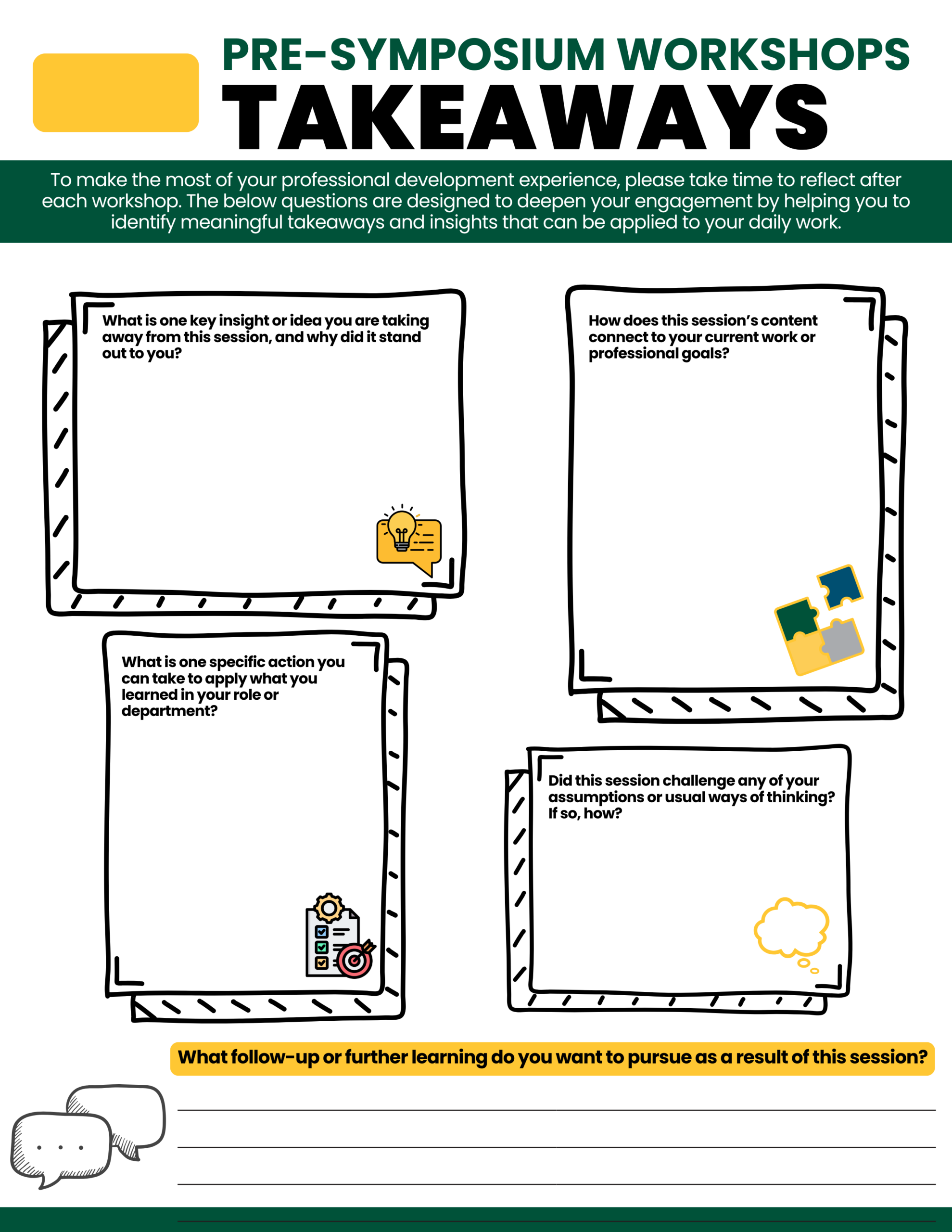
Professional Learning Worksheet
UL Student Success Symposium: Program Booklet
Professional Learning Worksheet
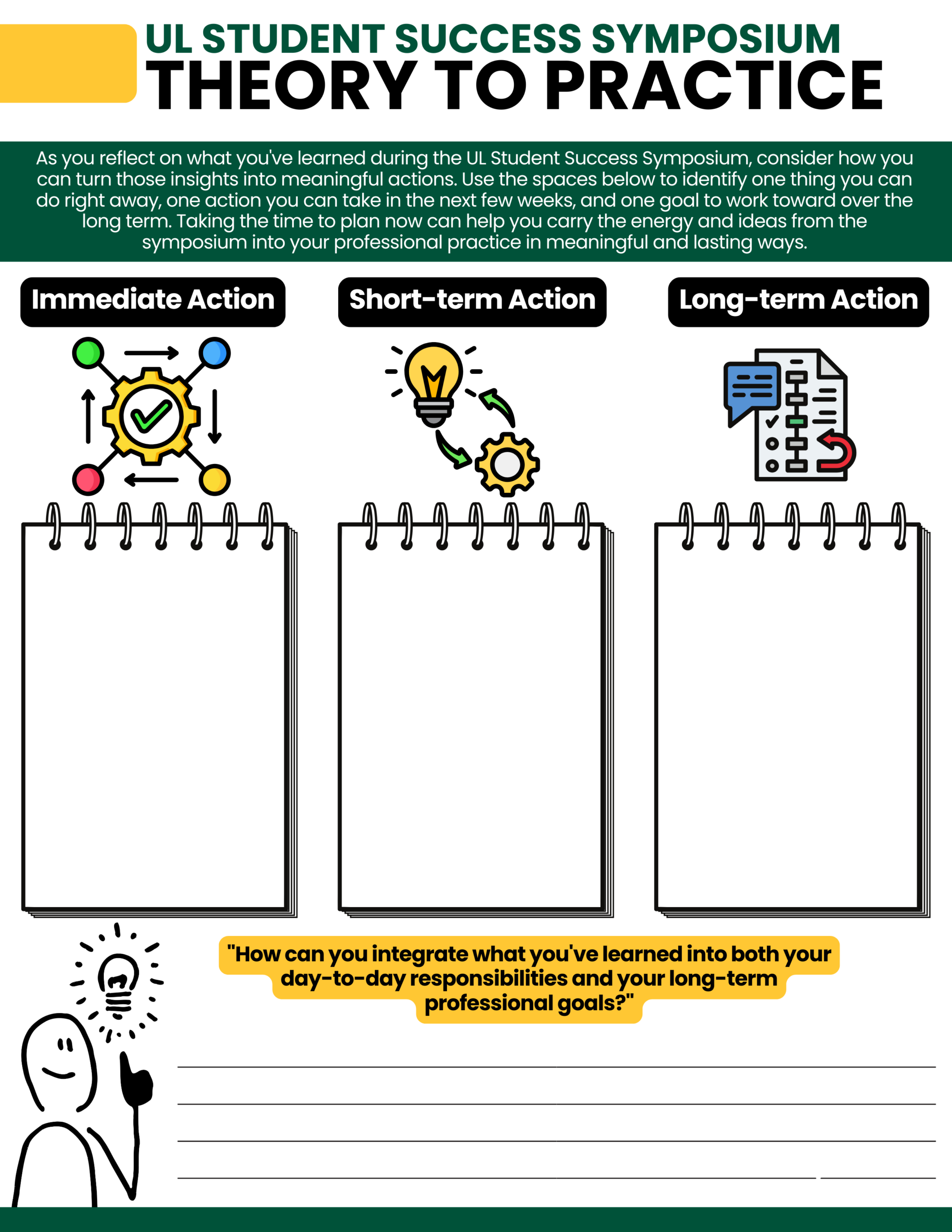
Theory to Practice Worksheet